
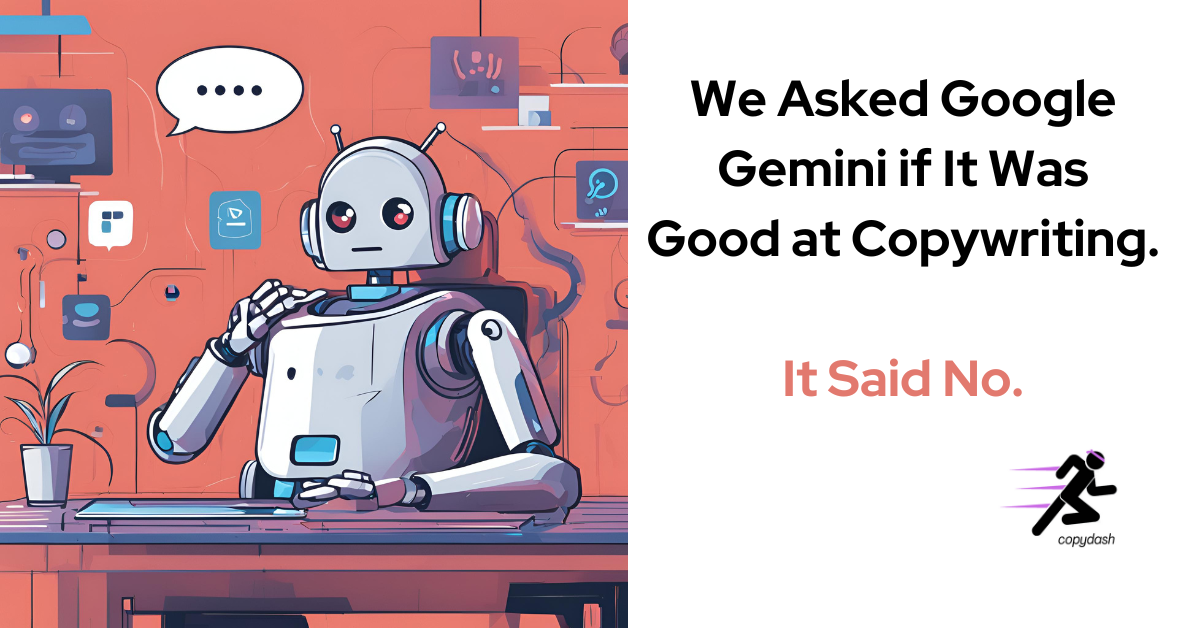
CopyDash is comprised of a team of expert human copywriters. But we do love a great AI copywriting tool that helps expedite the topic research and content development process (ethically, of course).
This made us think — if AI copywriting tools are great for R&D, why are they so bad at actual writing?
Simple answer: the best AI tools for content research and analysis aren’t conversational AI platforms. Even Google’s own chatbot, Gemini, says it’s not a full-fledged copywriting tool. (More on that later.)
Here are some key research findings about AI copywriting tools we’ll share with you:
- AI copywriting tools are best utilized in 3 key contexts: keyword research, outline generation, and optimizing copy written by humans.
- MarketMuse is our favorite AI-assisted copywriting tool. Its “live content scorecard” is a vital part of our content strategy and development. We also like product offerings from Ahrefs and Hubspot.
- Google’s own conversational AI says it’s not a copywriting tool. Copy and pasting chatbot content is never “net new content”, and it can negatively impacts your search ranking.
- The efficacy of AI copywriting tools relies on an ethical user. CopyDash has a standardized code of ethics for AI use in content research and development.
Ask about our AI policy in a strategy session with our founder and CEO — it takes 90 seconds or less to schedule.
What Is an AI Copywriting Tool, Exactly?
AI copywriting tools are software programs designed to assist human writers in the content generation process.

These AI copywriting tools are trained on massive sets of data, text, and code. These data sets include pre-existing web and digital content like websites, articles, blog posts, marketing materials and scholarly reports.
When an AI copywriting tool receives a user query, it pulls information from these data sets to curate a response it considers accurate and appropriate to the query.
It’s no surprise, then, that an AI copywriting service is only as good as the data it’s trained on.
Data Quality = A Good AI Copywriting Tool
Data quality is supremely important to AI content tools. Strong data quality reduces the chance of biased responses, increases response efficiency and reliability (DQLabs).
Leading AI experts warn about the “garbage in, garbage out” effect that bad data sets have on AI. Forrester reports that “data quality is now the primary factor limiting GenAI adoption”.
Here are 3 quality-of-life factors in AI content tools that are directly influenced by the purity of their data sets:
- Relevance. The goal of AI content tools should be to generate as pertinent of a response as possible to the query. Strong data sets include niche content about specific industries and cultural conventions.
- Nuance. Good data sets allow AI tools to understand the nuance of human language, tone and intent (e.g. carefully worded phrases and inferred reasoning). The best AI copywriting tools are beginning to generate responses that take human sentiment and intent into account.
- Bias avoidance. The more verifiable, truthful information an AI model is trained on, the less inherent bias its answers include. A good AI model is trained on a diverse array of reliable sources.
TLDR: AI copywriting software is only as good as the data it’s trained on, and its ability to properly interpret that data. The better the data, the better the AI tool — and vice versa.

Got questions about generative AI and Google SGE? Learn how Google SGE affects SEO and search visibility.
Good AI Copywriting Tools (And When to Use Them)
Smart content marketers identify high-quality AI copywriting tools, and the precise stages of the content development process where they excel.
AI-assisted content tools are a part of the CopyDash creative process. We use them in 3 distinct contexts:

- Keyword research and selection
- Outline generation
- Optimization of human-generated copy
Specific contexts require specific tools. Here are AI products we find useful in each of these clearly defined stages of content development:
- Ahrefs Keyword Explorer for keyword research and selection. Ahrefs has an excellent tool for long-tail keyword research as well.
- Hubspot’s AI Content Writer for outline generation assistance. We like that this tool offers guidance in optimizing titles and headers, and that it works well with human-generated copy content.
- MarketMuse for optimization of human-generated copy. We like MarketMuse’s ability to cultivate lists of secondary and relevant keywords to support the head keyword of each article. We also appreciate its ability to “score” content against competing articles.
At this moment, we do not think conversational AI is quite ready for prime time (aka our formal content development process). However, we do think conversational AI is improving at outline generation tasks, such as proper title and header conventions.
We aren’t the only ones who think conversational AI isn’t a copywriting tool. So does Google’s own chatbot, Gemini.
Gemini Says It’s Not an AI Copywriting Tool
Chatbots are for chatting. They’re not here to write your content for you.
Don’t take our word for it — we asked Google Gemini itself.

Gemini states that it can be a “supportive tool in the copywriting process, but it wouldn’t be considered a full-fledged copywriting tool on its own”.
Gemini went on to cite its shortcomings in control and nuance, and noted that the best copywriting requires human influence.
Our interest was piqued, so we went a step further. We asked Gemini: “Does Google punish websites that copy and paste conversational AI responses as their own content?”

Gemini told us that copy/pasting conversational AI responses into your website content “can negatively impact your website’s ranking”.
And if Google’s own AI chatbot is saying this, take heed.
3 Ways Conversational AI Falls Short for Copywriters
There are 3 primary ways that conversational AI and chatbots fall short at the actual task of writing copy.
- Unpredictable insights. “GenAI consumes structured and unstructured data alike,” explains Forrester. Vast, varied data sets mean that generative AI occasionally is trained on bad data and makes unpredictable leaps in predicting trends and future behaviors.
- No “net new content”. All AI response content is derived from the data it’s trained on — this means there’s no net new content in those responses. All those words came from somewhere else. While that’s not exactly plagiarism, copy and pasting off chatbots comes darn close to it. (Too close for our liking.)
- NLP and context. Natural language processing (NLP) is part of how generative AI processes human language. NLP isn’t great at interpreting context, subtext and ambiguity — and it can’t always differentiate between biased data and quality data.
3 Times Conversational AI Can Help Copywriters
There are several situations where conversational AI and chatbots like Gemini and ChatGPT can assist human copywriters in the content development process.
While these are highly specific circumstances, the speed and efficiency that generative AI provides in these 3 situations makes it a worthwhile tool:
- Transcription of existing assets. Got an audio interview, lengthy transcript or video marketing piece you need analyzed? Conversational AI reads and summarizes all that data in seconds — it would take a human copywriter hours.
- Citations you can cross-reference. Ask chatbots to provide links to cited sources where possible. Then, cross-reference and verify those sources for accuracy and credibility.
- Competitor analysis. Why not ask Gemini to digest your competitor’s websites and identify their keyword strategy? After all, it has the power of Google behind it.

SEO isn’t dead. We checked. Learn how Google SGE is using generative AI to make search better for users and brands.
Ethical Use of AI in Copywriting and Content Creation
CopyDash has a rigorous code of AI ethics for its copywriters, copyeditors and research team. We believe that the value of AI tools is defined by the ethics of the human using them.

These are the 4 pillars of CopyDash’s ethical AI use policy:
- Natural keyword use. Include relevant keywords throughout your content, but don’t stuff them in unnaturally. Make sure the keywords flow smoothly and read coherently for a human audience.
- Content that reflects search intent. Understand the “why” behind a search and tailor your content accordingly. Are users looking to learn, compare, or buy? Provide the information and answer their questions in a way that matches their intent.
- Optimization past the copy. A good SEO copywriter implements proper title tags, headings, alt text and meta descriptions within digital content to help search engines index and understand the copy. Keywords are supplemented by synonyms and related search terms to improve latent semantic indexing (LSI).
- Value-added content. High-quality content provides something new and unique to your audience. Search engines value fully “net new content” that isn’t a retread of other articles. Don’t be over reliant on other people’s quotes, statistics and existing content. A quality SEO copywriting service takes the time to add independent research and thought to its work.
Conclusion
There’s a difference between AI copywriting tools and generative AI. AI tools from sources like Ahrefs and MarketMuse provide focused value to specific aspects of the content development process.
While conversational AI is great at consuming large data sets and quickly finding citations, it’s not a quality tool for the actual practice of copywriting at this time.
And if you’re worried about getting optimized articles written at speed — well, the humans at CopyDash can do that.
Schedule a complimentary strategy session with our founder and CEO — get started in 90 seconds or less!


Leave a Reply