

SEO isn’t dead — yes, even with the rise of Google’s Search Generative Experience (SGE). But now more than ever, it’s crucial that you hire a content marketing agency that engages in ethical SEO practices.
Ethical SEO is the backbone of current search. It increases search visibility, enhances user experience, and creates a cohesive content structure that gives human readers and search engines an efficient way to navigate your website.

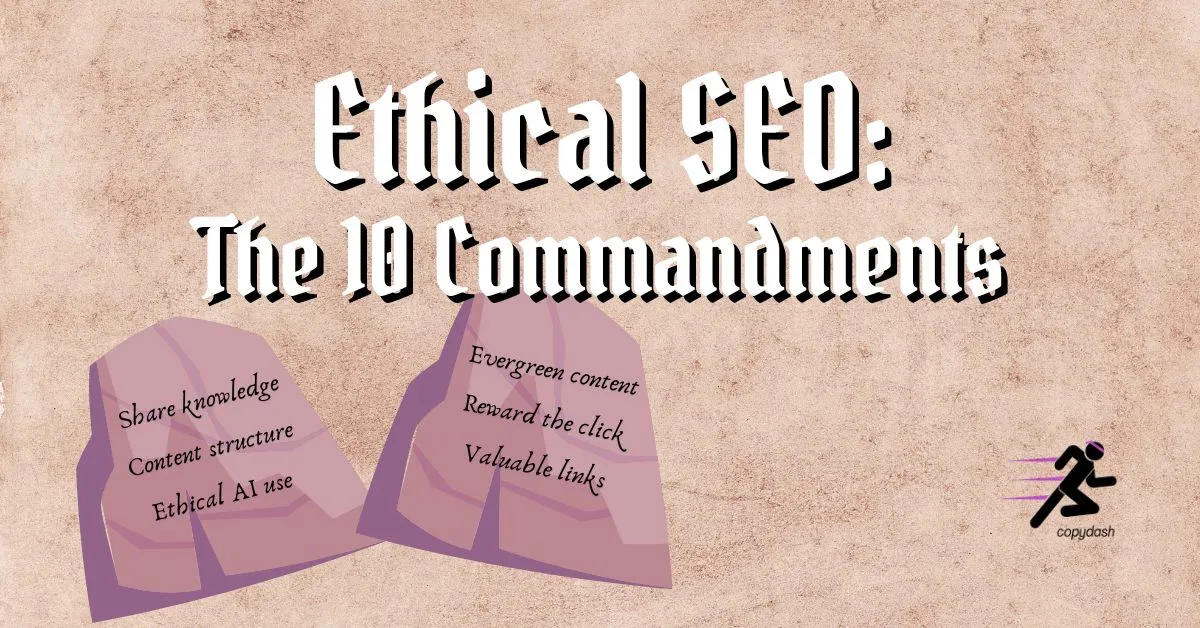
At CopyDash, we’ve created a list of 10 Commandments that ethical SEO agencies must follow. These rules are the foundation of effective content creation, good-faith generative AI use, and a value-driven experience for clients and their audiences.
- Ethical SEO means writing for humans first. Google rewards value-added content that thoughtfully and efficiently answers user search queries.
- Treat your clients’ audience like you treat your own. Provide a coherent content structure, and only use internal links when they add important information.
- Generative AI is a research tool, not a writing tool. Use conversational AI to inform your writing structure and obtain data. Don’t use it to write for you.
- Good SEO agencies share knowledge with their clients. Work with a content agency like CopyDash that teaches its clients how to implement ethical SEO content strategy.
Got 90 seconds? Book a free consultation with our founder to discuss your SEO content strategy goals.
10 Commandments for Ethical SEO Agencies
Our 10 guidelines for ethical SEO agencies focus on 5 core concepts:
- Humans matter. It’s important to gain visibility on search engine results pages (SERPs). But Google SGE creates a world where high-quality content that adds value to readers’ lives is inherently “bumped” in search results.
- User experience above all else. Every piece of copy is a chance to inform, enrich and enhance the user’s experience. Make sure your content achieves this goal.
- AI is a resource, not a content creator. Generative and conversational AI is a great research tool when used ethically. But it’s inherently not built to write your content.
- Content should be evergreen and optimized. Evergreen content checks all the “value boxes”: factual, searchable and long-lasting. Optimize all copy, even if it isn’t seen.
- Add value in every logical way possible. Find pathways to add value to everyone who touches your content — your clients, their readers, and searchers looking for answers.
Let’s dive into CopyDash’s 10 Commandments for Ethical SEO.
1. Write for humans first.
The rollout of Google SGE is driven by AI, but its goals are uniquely human. Featured snippets and AI curated responses are won by human-powered content that directly addresses the needs of each search query.

This focus on writing for humans means brands that rely on an outdated SEO mentality of “write for crawl bots and stuff those keywords” are getting punished in a big way.
Of course you say that, you might think. You’re a content marketer who wants me to stop churning AI-generated content and hire you.
Well, don’t just take my word for it! Professionals serving every facet of the sales journey have noticed the human focus behind Google’s search updates.
Intuit Mailchimp stated in a recent article, “Content that will win in search engines is written by humans, is unique and provides readers with new insights. Giving answers to a user’s question in more detail and based on experience will be key.”
And even if Google SGE didn’t reward valuable content for humans — real consumers still pay your bills. Why wouldn’t you cater to them first?
2. Build content around a cohesive structure.
Give your readers a clear pathway to travel through your content, and they’ll spend more time on your website. A strong content structure enhances user experience, creates a cohesive look and feel, and makes your website more enjoyable to visit.
Want proof? Contentsquare’s Digital Experience Benchmark states the average time on page across all industries is 54 seconds. Over our last 400 published articles, CopyDash earned an average time on page of nearly 4 minutes for our clients.
I like a content structure based on topic clusters built around pillar pages. Create a “tent pole” page focused on one core idea or business offering, then link to and from that pillar with a series of information-rich related articles that add credibility.
Pillar pages and topic clusters create an environment that invites engagements and clicks, funneling readers through multiple pages of your website.
A quality content structure comes with a built-in bonus — it makes your website simpler for search engines to read, analyze and comprehend.

Learn more about the search visibility power of topic clusters and pillar pages.
3. Treat your clients’ audience as well as you treat your clients.
Good SEO agencies understand their clients. Great SEO agencies understand their clients’ clients.

It’s easy to write copy that panders to the client. Discover their style, learn their preferences, and write to match. That’s great — but it doesn’t guarantee search visibility or on-page conversions.
What clients really need is an SEO agency partner who knows how to engage their audience.
It’s an SEO content company’s obligation to research the end users of its clients’ products and services. Great SEO copy goes beyond what the client needs — it delivers what the target audience wants.
4. Don’t just earn the click — reward the click.
It’s easy to lean on simple metrics like clicks and page rankings. Yes, it’s wonderful you got all those clicks — but do they actually deliver any value?
Once your reader is on the page, are they happy to be there?
Don’t just earn the click. Reward the search user’s time and attention with a 3-step approach to quality content:
- Answers first. Get to the point. Figure out what the search query was really asking, then answer it — quickly and clearly.
- Relevant content second. Back up your primary answer with valuable, information-rich content. Write what’s necessary to add context to your reader’s experience. Delete fluff.
- Spam never. Don’t sell to people who aren’t ready to buy. Don’t ask for conversions that aren’t relevant to the on-page topic. Create a great experience, build user trust and brand authority, and you won’t have to spam for conversions.
TLDR: Give the readers what they want, and they’ll trust you enough to keep coming back.
5. Generative AI is a research tool, not a content writer.
It’s okay to use generative AI tools to conduct research into your content — I do it quite often. AI has the amazing capacity to browse millions of sources for information in the time it takes me to take a sip of coffee.

You should take advantage of this power — but you should never copy and paste AI responses into your content.
Why can’t I just rip content from AI chatbots and paste it?, you may ask.
It’s too risky. Generative and conversational AI tools are trained on large sets of data. They use these data sets to inform their responses to your queries. But what happens when bad data infiltrates those sets?
Always fact-check your generative AI research — quotes, statistics, everything. If you can’t independently verify the information you find in an AI search, don’t use it.

Check out CopyDash’s 4-point guide to ethical AI use, and learn why it’s a vital part of our content development process.
6. Place a focus on evergreen content.
Evergreen content is forever. Or as close to it as digital content gets.
Your content strategy is an investment — in money, in time and in resources. That investment should provide value and produce returns for as long as possible. Placing a focus on evergreen content makes that possible.
The longer a piece of digital content is factual, relevant and accurate, the more valuable it gets. It has longer to become entrenched as a shared link, a data source, and a visible search asset.
You’ll occasionally need to speak on short-term topics to remain timely, of course. But spend the majority of your content strategy on evergreen content. Make occasional edits for quality assurance, then leave it to flourish for the long haul.
Ask a potential SEO agency partner about their pathways to evergreen content creation. Make sure their vision for long-lasting wins aligns with yours.
7. Optimize all content — even the content they can’t see.
Every piece of metadata and descriptor text is an opportunity to optimize content on your website. Make sure to optimize these “hidden” pieces of content for search engines:
- Meta tags
- Alt text (images and videos)
- Meta description
- Title tag
- Proper headers (H2s, H3s, etc.)
Every element on your page is a chance to provide more context to search engines. Leaving these fields blank makes the images, videos, titles and other HTML data useless.
8. Keyword stuffing is not keyword strategy.
There are wonderful tools like MarketMuse (which CopyDash uses) that help copywriters score their written content against competitors. But be careful not to over-optimize your keyword strategy.

Keyword stuffing is the practice of jamming related keywords into your copy to boost your visibility in search results. But this often results in the opposite effect — your content sounds spammy, it feels inauthentic, and it turns readers away.
The net negative effect of keyword stuffing is two-fold:
- Human readers are turned off by your awkward-sounding content. This results in less time spent on page, which damages your brand authority and search rankings.
- Search engine crawlers are more likely to evaluate your content as spam and devalue it in SERP results.
Write coherent, concise content about your topic with targeted use of keywords. You’ll avoid being punished by search engines, and deliver value to your audience.
9. Every link must provide additional value.
On the subject of delivering value — every link within your content must enrich the reading experience. This pertains to both external and internal linking strategy.
Adding external links with no relevance to your content confuses readers and search engines. This is done for 2 primary reasons:
- Monetized backlinks. It isn’t worth grabbing a quick buck on a backlink that doesn’t enhance your topic. It’s more likely that your reader will click that link, become confused, and never return. There’s nothing wrong with paid backlinks — but make sure they’re relevant to the content in which they appear.
- An attempt to build authority. Links to sites with high domain authority are thought to enhance your own content rankings. However, if these links aren’t pertinent to your content, search engines won’t know how to evaluate what you’re truly writing about — and your rankings will suffer.
It’s also tempting to jam internal passing links into your content in an attempt to increase viewer clicks per session. But again, think of the negative ramifications — readers will click away from the topic they were interested in, and find themselves somewhere they didn’t want to be. Your brand authority and trust decrease as a result.
TLDR: If you add a link to your digital content, make sure it leads somewhere that logically adds value to the searcher who follows that link.
This link has value! You’re one click away from a free consultation with our founder — let’s find content solutions for your brand together.
10. Share knowledge and expertise with your client.
Work with an agency partner who openly shares knowledge about SEO best practices and quality content strategy.
An ethical SEO company doesn’t “paywall its expertise” in order to nickel-and-dime clients down the road. Clients should be educated and empowered to take as much control of their future content strategy as they desire.
If you’re working with an SEO agency that’s secretive about most aspects of their approach to content development, that doesn’t sound much like a partner to me.
Your Brand Deserves an Ethical SEO Agency Partner
Ethical SEO practices matter more than ever — to clients, to readers and to search engines.
Clients benefit from a trustworthy, transparent agency partner that’s willing to share expertise and educate them on their own content approach.
Readers enjoy a search experience that fulfills their queries, answers their questions, and leaves them impressed by your brand’s ethical approach.
Search engines get a clear roadmap through your website. They understand exactly how to analyze your content structure, what your brand represents, and the most logical way to display your site on SERPs.
Start your journey to evergreen SEO content strategy! Step one is a free strategy session with our founder — sign up in under 90 seconds!


2 responses to “The 10 Commandments of Ethical SEO Agencies”
[…] The 10 Commandments of Ethical SEO Agencies […]
[…] our 10 Commandments for Ethical SEO and find an agency partner that passes the […]